' the Woodlouse

Pages

Saturday, 30 July 2011

Cobwebs and measuring headaches


The most taxing mission yet (mentally at least) has been gathering the measurements necessary to arrive at the above sketch of the main roof trusses.  It looks so simple now it's done, but gave me major headaches as every time I tried to draw it in Sketchup major bits refused to meet where they should.  Unsurprisingly the bulk of the problems were my fault, usually not notating my on-site sketches clearly enough, thinking I'd measured from one point when in fact I'd measured from another.  The same issue applied when translating the measurements on the computer, starting a distance guide from the wrong point etc.  After a few trips back and forth from the bungalow I got it sorted, and was able to email the crucial info to Kuba (our designer).  The purlins in the sketch (long chunky timbers running the length of the roof to support the rafters - barely visible on the skethch as they're end on) still don't sit quite where they should, but I blame that on the impossibility of using perfectly straight lines to represent a fifty-year-old timber structure.

Thursday, 28 July 2011

A good pair of boots


It's been a week or so of structural fact-finding missions for me and the bungalow.  Lots of crawling about in the loft, lifting roof tiles, sticking my head into small spaces to see what's going on (or just hands and camera into the smaller holes), and digging down through clay.  Large hairy spiders and their face-clinging webs are featuring large, and no doubt will do so in increasing amounts from now on.

The foundations.  Featuring large quantities of concrete, splashed liberally around and up the sides of the orginal foundation trench...

Friday, 22 July 2011

The importance of fitting in

Before deciding to make an offer on the bungalow I went to talk to the local planning officer again.  We needed to know what the planners' reaction might be to a strawbale wrap and extension of the bungalow.  The short answer is "mixed".  Normally, within certain criteria to do with size and materials that match the existing structure, side or rear extensions are covered by "permitted development" rights.  As long as you meet the criteria you can go ahead and build once you have building control approval (to ensure the construction meets current standards).  As Bridport lies in an Area of Outstanding Natural Beauty (AONB) all side extensions here need planning permission, as do any that don't match existing building structure.

So straight away, our project quite rightly does require planning permission.  This is then more likely to be given if the plans still comply with the restrictions normally covering permitted development.  Our plans clearly won't...  The planning officer was extremely helpful and generally supportive, but of course he has to work within the guidelines and regulations governing planning and development.  He explained that the main problem we might have comes down to the visual change from a brick bungalow (in a street of brick bungalows) to a rendered one, as the strawbale walls will have to be rendered.  He said that just extending with straw, but leaving the main building as brick would probably be fine, but was hesitant about the wrapping of the whole building due to the conflict of this with the guidance that development should be in keeping with surrounding structures.

Monday, 18 July 2011

Fact backed rant

I think it might be time for a bit of explanation of why we want to wrap a perfectly good bungalow in straw.  Because - like so many buildings - it isn't actually perfectly good.  It is structurally sound and mostly weather proof, both of which are very good things, but it is also cold, very poorly insulated, would require huge amounts of energy to heat, and is massively prone to condensation-related damp problems.  By wrapping it and extending it with strawbales (along with associated works to insulate floor and roof, and careful attention to details of design and construction) we aim to produce a home that is super-insulated, so requiring very little energy to maintain comfort levels, and remaining pleasantly cool in summer.  When necessary in the coldest parts of winter top-up heat would come from a highly efficient and beautiful masonry stove  in a central position (more on these at some point in the future) from where heat can easily circulate throughout the home.

But why straw and not some more common kind of insulation material or construction technique?  I've covered this is general terms before, so this time here are some numbers to back it up.  The key figures here relate to the insulating capabilities of materials and to their embodied energy.  Embodied energy represents the amount of energy used to make a product, including extraction of raw materials, processing, transport, installation etc.  There are different means of calculating this ranging from "cradle to gate" - preferred by some manufactures at it gives the lowest figure as calculations stop at the point the product leaves the factory, to "cradle to grave" preferred by most environmentalists as it provides the most accurate estimate of the energy consumed in a material's entire lifespan.  Generally, the higher the embodied energy of a product the higher the associated carbon emission from it's production and use, though this could potentially vary depending on the processes and source of energy used.  Even when renewable energy is used it is still important to move towards low energy use throughout production though, in order to ensure sustainability of energy supply.

Wednesday, 13 July 2011

The Bungalow

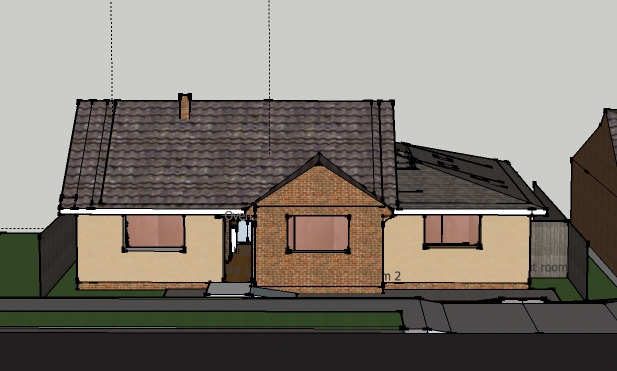
So then, the bungalow.  It's a two bed brick built, cavity walled, bog-standard 60's bungalow, that has mostly been left alone apart from basic redecorating and the removal of one wall.  The back of the bungalow and the garden are south/south-west facing, on a gentle slope, so are near perfect for catching the sun.  A very skinny stray cat has taken up residence in the "sun room" (a rotten shed-like extension with windows) after apparently being left behind by some people who moved away from across the street.  It's very friendly, which is nice, but clearly pretty ill too.  If it's still alive by the time we move in (we give it food and water when we're up at the bungalow by way of helping that happen) it's unlikely it and our small yappy type dog will get along well, but they just have to cope with that.  It's home will be disappearing at some point in any works too, but we'll cut it a hole in the shed so it can hang-out there instead.

The plan is to super-insulate the existing bungalow by externally wrapping it in new strawbale walls which will sit tight against the outside walls, and build a strawbale extension.  The image above is a guestimate of how it might look.  My 3D design skills didn't exist before I started trying to design possible layouts so there are lots of errors in the model, and it's liable for wholesale change once our strawbale building designer gets going on it shortly (http://jakubwihan.com/) - but it gives a rough idea.  I'll explain next time why the front bedroom that extends forward of the main building is left as brick.

Progress report (there has been progress...)

Apparently my last post was 10 months ago. There wasn't much to report over the winter as housing and land markets had their winter dip, then I just got a bit down and frustrated about the whole thing and didn't feel like writing the blog. Then suddenly quite a lot started happening and I thought about writing but haven't got around to it until now. I will try and update much more regularly now, at least once a month but more often when there is more to say.

As quite a lot has happened I'm not sure where to begin today. We have now bought an old bungalow to give a strawbale upgrade. I've been busy researching lots of things in relation to this, learning to use Google's Sketchup program (free 3D design software), drafting rough design possibilities for the bungalow, digging exploratory holes in the garden and more. That's easily a whole blog post in itself, so I'll return to it in more detail shortly. In the meantime, some kind of general update is probably in order.

As I said in the last blog, we decided to separate home and treatment room from pottery workshop and kiln, allowing us to live nearer the centre of town than we would be able to with kiln, workshop and home all together. The hope was that it would also make it easier to find suitable sites where planning permission was possible, and impact of any new build would be low.

Friday, 3 September 2010

Conservation Conversation.

Today we finally went to talk to a planning officer, motivated by a couple of possible plots which have come onto the market in roughly the right area for us, but in conservation areas.  More on conversation with the planning officer in a moment.  First a bit of an update...

We seem to have found our first area of compromise within our occasionally conflicting list of aims and criteria for a site.  In some ways it's a big departure, but mostly it makes a lot of sense.  It certainly feels possible, which is definitely progress!  The original ideal scenario was to have have home, workshop, treatment room, kiln and coppice in the same place; not just any old place but a place right on the edge of town, so that clients could easily get to it and we could get into town on foot or electric mobility scooter.  This is a lovely idea, but frankly impossible.  As discussed in previous blogs, this would mean a whole load of building outside the DDB (Defined Development Boundary), which would be highly unlikely to get planning permission even if we could find what we thought was a good site.  The planning officer (PO) confirmed that anything residential outside the DDB would be refused unless directly linked to an agricultural need to be there.  In any case, we have only seen one site that ticked most of the boxes for this plan, and that never reached auction.

Wednesday, 9 June 2010

Strawbale Frenzy

Last week I was on a fantastic Building With Straw-bales course run by amazonails and held at the Centre for Alternative Technology (CAT), near Machynlleth in Wales.  The course was massively inspiring and motivating, to the point that on the train home I ended up eulogising about the virtues of straw building to a young couple (un)lucky enough to be standing in the same vestibule as me on the train between Birmingham's New Street and International. At Birmingham International I met a couple of friends who I was staying the night with, and despite having arrived 2.5 hours late (due to a poor, overworked train from Machynlleth which was overheating "due to the hot weather" that day) I still managed to have a crack at persuading them the best way to build their planned extension was (of course) with straw, before finally giving in to tiredness and need for bed.

I think the rampant evangelical fervour has now calmed slightly, but the course certainly confirmed and amplified everything I'd been suspecting about what a truly genius way to build, straw is.  Here's some reasons why: 

Monday, 17 May 2010

Planning issues - Part 3

I think when I first read the Local Plan planning policy documents I was either in a very optimistic mood, or reading late at night when my mind was shutting down, or quite likely both.  The positive bits of policy I thought would apply straightforwardly to our eventual planning application now seem to me not quite so clear-cut.  But there are still helpful statements in the local plan and also some Regional and National planning guidance that could help us get the go ahead once we’ve found a site. 

The Local Plan allows for limited development outside the DDB (Defined Development Boundary) of a town/village in certain cases.  Here are those that I think could apply to our scheme:

  • Dwellings for which there is proven local need (either for affordable housing – which won’t help us in our application, or essential rural workers dwellings – which might be relevant to us)
  • On site replacement of dwellings
  • Conversion/replacement of buildings
  • Employment development
  • Tourist, recreation or community facilities appropriate to a rural area.

Friday, 14 May 2010

Planning issues - Part 2


What is our scheme, and why would we need to build outside the DDB (Defined Development Boundary – see last blog, Planning issues – part 1)?

We want to build ourselves a home and place to work.  We want it to be built using as sustainable materials as possible, and to have as little impact as possible both on the actual site and on the environment in general.  Practically this means building with straw-bales, sustainably grown timber, little or no concrete.  We’ll be aiming for as high a rating as possible according to the Code for Sustainable Homes which details high specifications for energy efficiency, insulation, energy use and ventilation (I’m likely to write more about this in later blogs, along with more about building and materials, as I find out more).

It’ll be a single story, green-roofed home, with a separate building for workshop and a massage (and other) treatment room on site.  The wood-fired pottery kiln would also be on site.  I want to try and grow most (if not all) of the wood for firing it on site as coppice.  BTCV (British Trust for Conservation Volunteers) website indicates that 5 acres of coppice should produce up to 6 tonnes of mixed hardwood a year (once mature), which is equivalent to 2 firings a year of a large kiln (provided I get the design right, the wood is well seasoned, and the kiln works well!).